

In 2023, the MPHA Board of Commissioners approved a five-year strategic plan to guide the agency’s work through 2027, outlining a detailed plan with six primary goals. The plan reflects four main priorities: people, preservation, production, and partnerships. These priorities are at the core of the plan’s strategies and actions.
In 2025, the agency made considerable progress towards its six goals. Here are some 2025 progress highlights:
Goal #1: Preserve and provide deeply affordable, high-quality housing for high-rise residents.
The agency worked towards this goal with three major projects: breaking ground on the largest public housing redevelopment in city history, investing millions in high-rise repairs, and renaming a building to honor a long-time community advocate.
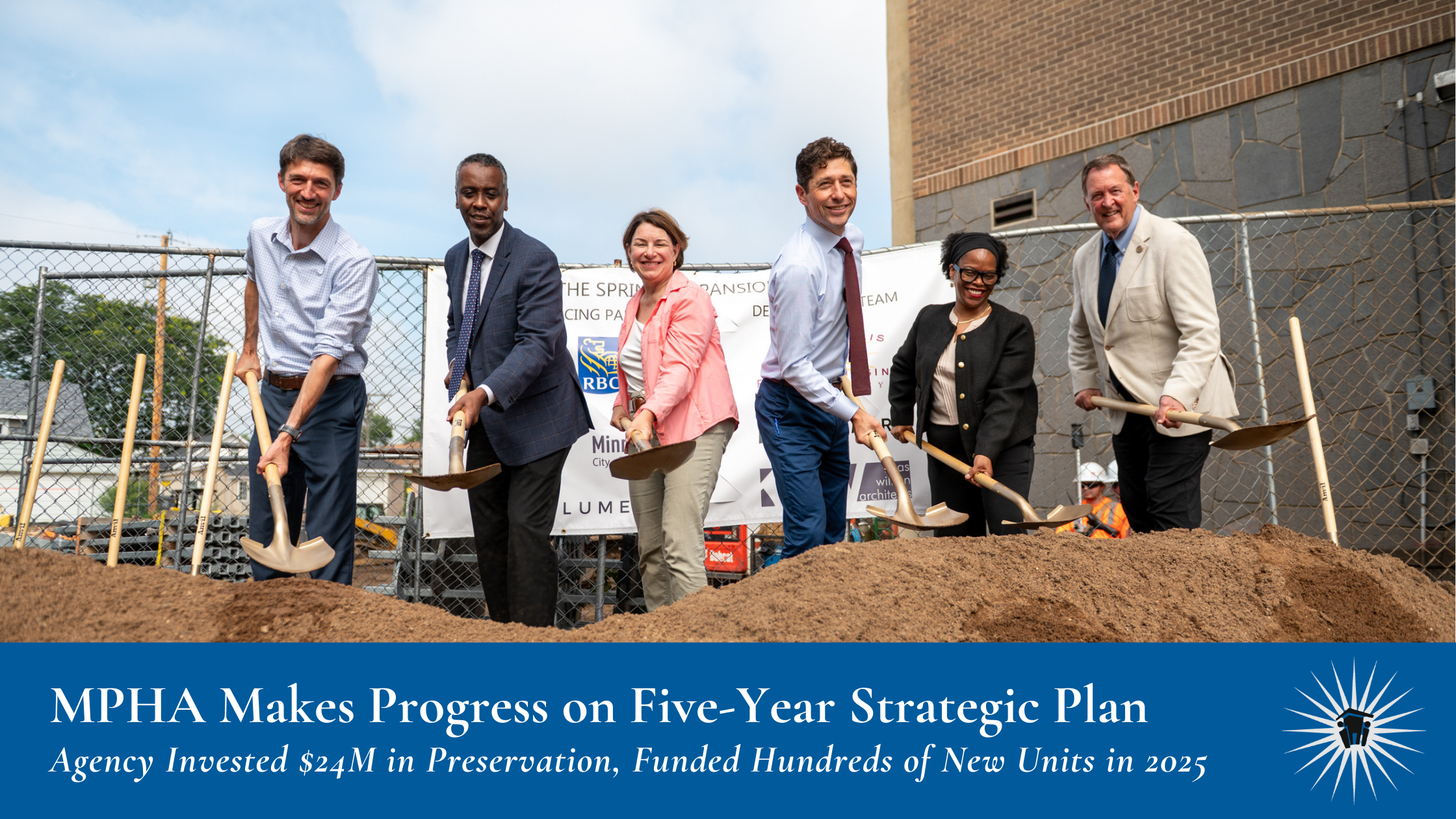
- In August, MPHA broke ground on the Springs Manor redevelopment project, the largest public housing redevelopment in city history. The estimated $78 million project will preserve 221 units while constructing a new four-story building with 15 deeply affordable and disability accessible units.
- In 2025, MPHA invested more than $20 million in repairs across its high-rises. Major projects included electrical system upgrades, boiler system replacements, roof and window replacements, fire protection system upgrades, elevator modernizations, exterior façade restorations, and security improvements.
- In February, MPHA renamed the Sibley Triangle Apartments (616 Washington Street NE) to the Alice M. Geronsin Apartments in honor of long-time resident and community advocate Alice Geronsin. In August, residents, staff, and community leaders gathered to celebrate the renaming of the building, unveil new building signage, and remember Alice’s life together. Building residents led the effort to get the building renamed after Alice passed away in 2024, recognizing her unwavering dedication to improving the quality of life for her fellow residents.
Goal #2: Build new and expand partnerships with federal, state, and local governments, in addition to philanthropic entities that support MPHA residents and those on the agency’s waitlist.
MPHA made progress on this goal through the Highrise Health Alliance’s mini grant program, Pathways to Success Program, and new funding for Stable Homes Stable Schools.
- The Highrise Health Alliance created a mini grant program aimed at strengthening social connection between residents. All told, residents used grant funding to host more than 25 community building projects and events in 2025.
- MPHA celebrated the first MPHA family to successfully achieve homeownership through MPHA’s new Pathways to Success partnership. The partnership connects MPHA families with Twin Cities R!SE to deliver career readiness training, PRG, Inc. to provide specialized financial coaching and credit remediation services, and Twin Cities Habitat for Humanity to connect families with homeownership education, financial coaching, and homebuying tools.
- In 2025, the Stable Home Stable Schools (SHSS) received new one-time and ongoing funding. Mayor Frey included a $1.4 million annual increase to SHSS funding in his proposed 2026 budget to cover a funding gap on an ongoing basis. One time investments include a $900,000 grant from Minnesota Housing as part of a $1.5 million Homework Starts with Home grant to Hennepin County, a $350,000 Pohlad Family Foundation grant to support SHSS’ housing stabilization programming, and most recently Minneapolis City Councilmember Robin Wonsley led a successful city budget amendment to direct $1.4 million to SHSS.
Goal #3: Provide and preserve deeply affordable, high-quality family housing.
The agency advanced this goal with three key accomplishments: breaking ground on new multiplexes, repairing 100 family homes with the help of state funding, and establishing a vision and action steps for the future redevelopment of Glendale.
- In October, MPHA broke ground on a new triplex and duplex. The triplex will include two four-bedroom, two-bathroom units and a two-bedroom, one-bathroom unit. The duplex will include a four-bedroom, two-bathroom unit and a two-bedroom, one-bathroom unit. Both multiplexes replace MPHA-owned single-family homes and will be all-electric and energy efficient, including rooftop solar arrays.
- This year, with the help of state funding, MPHA invested more than $4.3 million to repair its portfolio of nearly 800 deeply affordable family homes. The agency completed major exterior enveloping renovations at 65 homes and “deep turns” at 35 more. With 100 newly renovated homes, MPHA is better equipped to serve families for generations to come.
- MPHA held numerous Glendale community meetings in 2025 to learn more about how residents feel about their homes and to discuss the current challenges associated with the capital backlog at Glendale. In October, MPHA outlined a set of visioning guidelines and action steps the agency will take to begin moving to the next phase of planning for Glendale. MPHA will finalize and announce the plan for Glendale’s future in 2026.
Goal #4: Increase supply of deeply affordable housing by at least 150 units per year.
Working to increase the supply of deeply affordable housing in Minneapolis, MPHA supported several affordable housing developments with Project-Based Vouchers (PBV) and broke ground on its own new units. Rather than the traditional tenant-based Housing Choice Vouchers awarded to an individual or family, PBVs sit with physical building units. This provides developers a long-term source of revenue and takes the burden off individuals needing to secure their own housing and instead creates a pipeline of subsidized units across the city.
- In 2025, the agency awarded 35 PBVs. Additionally, 179 PBVs awarded in prior years came online, meaning the units were constructed and individuals or families are living in them. MPHA staff attended various PBV groundbreakings and grand openings, including the Native American Community Clinic bringing 83 affordable housing units to the American Indian Cultural Corridor.
- Additionally, MPHA broke ground on the Spring Manor redevelopment and two multiplex family unit projects which will bring 18 new deeply affordable and disability accessible units.
Goal #5: Position MPHA as an employer of choice.
The agency made progress on this goal by hosting employee trainings and ensuring employee benefits are maintained.
- MPHA hosted employee trainings on Microsoft Office applications, inspection standards, human resource practices, after-hours protocols, Yardi data management, and property management.
- MPHA completed union negotiations with American Federation of State, County and Municipal Employees (AFSCME) regarding pay and Local 363 regarding fair working conditions to ensure employees are well compensated and supported. With more than 80 percent of MPHA team members represented by a labor union, the agency leadership is proud of the strong working relationship it maintains with the various unions.
- Additionally, MPHA effectively transitioned its Health Reimbursement Arrangement and Voluntary Employees’ Beneficiary Association benefit provider to maintain the benefit for employees.
Goal #6: Continuously improve organizational performance to retain MTW status and highest HUD performance rating.
The agency advanced this goal by reporting clean financials, maintaining compliance with HUD standards, training staff on new processes, and ensuring our information security system is secure.
- The agency reported clean financials. This builds upon years of zero audit findings and the highest confidence from the independent auditor.
- Additionally, in HUD’s 2024 compliance report, the agency exceeded all five Moving to Work (MTW) statutory requirements. These measures ensure the agency is serving very low-income households, has set a reasonable rent policy, serves substantially the same number and mix of households since becoming an MTW agency, and maintains Housing Quality Standards.
- To maintain a high standard of customer service, MPHA hosted continuing education training sessions for team members throughout the year focused on inspection standards, after-hours protocols, property management, Rental Assistance Demonstration Project-Based Vouchers, and Microsoft programming.
- MPHA’s Information Technology team utilized a third-party to test the strength of the agency’s security system. This proactive approach helped identify areas of improvement to reduce risk.
