

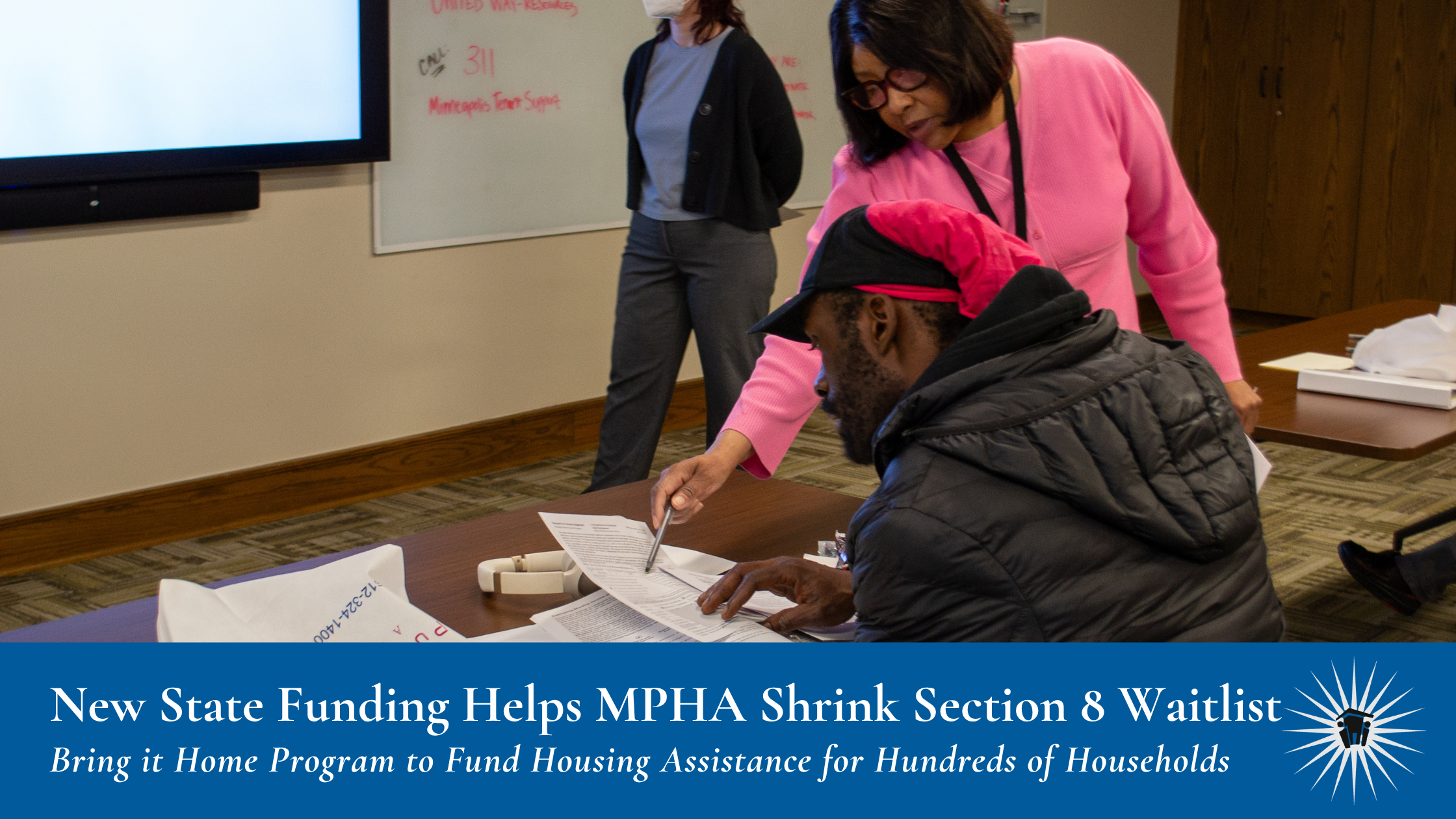
Earlier this month, MPHA began working to substantially reduce its Housing Choice Voucher waitlist using $21 million in funding from Minnesota Housing’s new Bring it Home (BIH) program. Currently, there are 337 households on MPHA’s federal voucher waitlist from when the agency last accepted applications in 2019. Every eligible household from the waitlist will be offered the new state-funded BIH housing assistance. Agency staff anticipate starting to process voucher applications for eligible households from the federal waitlist in August so they can begin searching for eligible rental units this summer.
Last year, Minnesota Housing awarded MPHA a two-year, $21 million grant to administer BIH in Minneapolis. The $21 million award is estimated to fund the equivalent of 600-700 federal vouchers. Minnesota Housing and MPHA finalized the necessary funding agreement enabling MPHA to begin administering BIH earlier this spring. Currently, MPHA administers nearly 7,500 Housing Choice Vouchers, benefiting more than 18,500 people. More than 90 percent of MPHA’s 7,500 voucher holders are at or below 30 percent AMI.
“The state’s new Bring it Home program will help hundreds of families and children in Minneapolis access stable, affordable housing,” said Abdi Warsame, Executive Director/CEO of the Minneapolis Public Housing Authority. “At a time when our city and region face an affordable housing crisis, this new program will ease that burden for hundreds of low-income households. I am deeply thankful to all the state leaders involved in establishing the Bring it Home program.”
Minnesota Housing’s new BIH program is modeled after the federal Housing Choice Voucher program. In the federal program, housing authorities provide low-income households with a rental assistance voucher to rent a home from participating property owners whose property is inspected and deemed to meet program requirements. The household typically pays 30 percent of its income toward rent, and the voucher pays the remainder of the monthly rent costs up to an amount established by the U.S. Department of Housing and Urban Development (HUD). The new BIH program will operate similarly, with local housing authorities administering the program to provide rental assistance for low-income Minnesota families (defined as cost burdened households at 50 percent Area Median Income (AMI) or below).
Because of different program eligibility requirements between the federal and state voucher programs, agency staff anticipate a small number of federal waitlist households will be ineligible for the new BIH program. Additionally, participants in MPHA’s BIH program are restricted to living in Minneapolis, whereas the federal voucher program provides greater geographic flexibilities. As a result, agency staff anticipate some eligible households will opt out of the BIH housing assistance as they continue to wait for a federal voucher. Households will maintain their spot on the HCV waitlist if they are ineligible or otherwise decline enrollment in BIH.
With less than 400 households on MPHA’s current federal waitlist and new state funding for the equivalent of 600-700 federal vouchers, agency staff anticipate MPHA will have additional funding to assist households beyond those already on its federal waitlist. The exact number of additional households that can be served will not be known until after agency staff complete the enrollment of eligible and interested households from its existing federal waitlist this summer.
As a result of this additional funding, MPHA intends to open a BIH waiting list to the public later this year—the first time MPHA has accepted public applications for any tenant-based voucher since 2019. The agency will provide additional details and waitlist opening dates as more information becomes available in the coming months.
###
MPHA is not currently accepting applications for its Housing Choice Voucher or Bring it Home waitlists. For those currently needing housing assistance, the agency is accepting applications for its non-family public housing general occupancy (ages 18-49), near elderly (ages 50-61) , and senior housing (age 62+) waitlists.
