

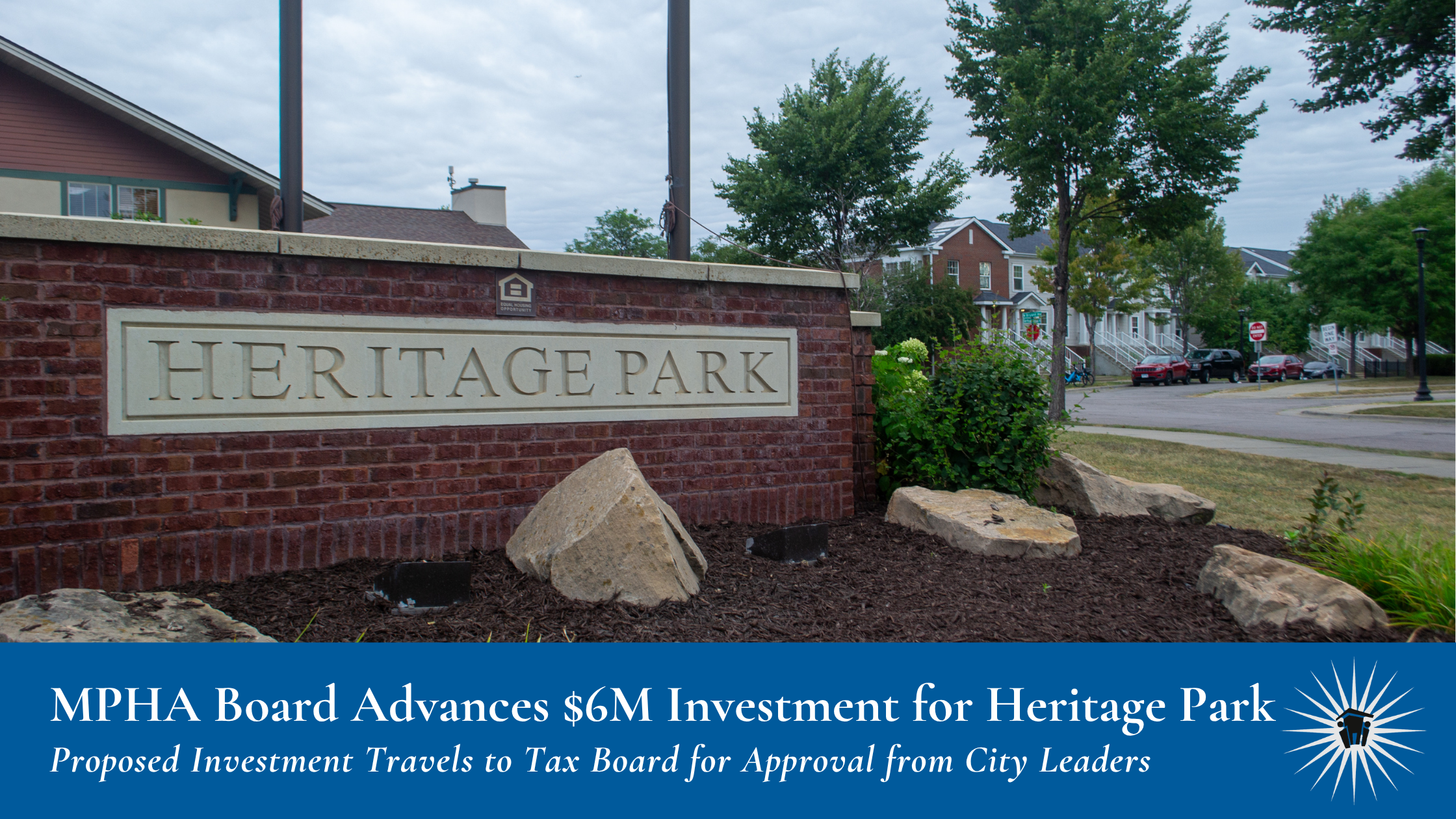
Today, the Minneapolis Public Housing Authority’s Board of Commissioners voted to approve a $6 million investment in near-term needs and long-term stabilization efforts to help restore Heritage Park. MPHA is repurposing funding from other agency projects as well as using a portion of its annual housing levy to fund the proposed investment. The plan now travels to the Minneapolis Board of Estimate and Taxation, where agency leaders will present the proposed investment on September 9. If approved, this would bring MPHA’s investment to more than $18 million since 2022 to support the site.
“MPHA is committed to meeting the moment at Heritage Park by coupling the $12 million the agency has invested at the site since 2022 with this proposed new $6 million dollar investment to support Heritage Park residents,” said Abdi Warsame, Executive Director/CEO of the Minneapolis Public Housing Authority. “Agency staff have been working to address the challenges at Heritage Park for years, including leading the work to have the site’s former owner assign the property to creditors and have a Hennepin County court appoint a third-party receiver in December. Until recently, there has been limited political will to join MPHA in investing meaningfully in Heritage Park. I am deeply thankful for the advocacy of Councilmember Warren to elevate the issue and spurring additional city investment in the site. In partnership with the city, state, HUD, and other stakeholders, we can restore the once vibrant Heritage Park community.”
Heritage Park is currently controlled by a court-appointed receiver. In December 2025, the site’s former owner, McCormack Baron Salazar, agreed to assign the property to creditors. Subsequently, a Hennepin County court removed McCormack Baron Salazar from operational control of the site and appointed a third-party receiver, Certus Financial, to take control of Heritage Park. While MPHA owns the land Heritage Park sits on, the agency has not owned, operated, or controlled any housing units at Heritage Park, including units receiving public housing subsidies, since it was built.
Funding Plan
MPHA’s proposed $6 million investment falls into two buckets: $3 million for near-term needs and $3 million to support long-term stabilization of Heritage Park. In both near- and long-term work, MPHA will provide financial resources to the site’s court-appointed receiver, Certus Financial, who will then deploy the funding in close coordination with MPHA, the City of Minneapolis, and the site’s property manager, Property Solutions & Services LLC (PSS). MPHA may adjust elements of this proposed funding plan as other resources from stakeholder partners are invested in the site.
The initial $3 million investment will help cover operating shortfalls at the site (funding activities like property management services, grounds and building maintenance, insurance, utilities, etc.), costs associated with predevelopment work to use HUD financing tools in major rehabilitation projects, transfer assistance for residents, and more immediate and near-term capital needs at the site, including moisture remediation efforts.
With funding to support work in the near-term, MPHA is also proposing to invest $3 million of its 2027 housing levy to help fund a future major construction project to stabilize Heritage Park. While Certus Financial is leading the work on this large-scale effort, MPHA is assisting Certus Financial secure other potential financing sources for the project, including ongoing federal subsidies, Low-Income Housing Tax Credits, bonds, debt, and soft sources—all aimed at helping address capital needs at the site, estimated to be at least $55 – 65 million.
While there is still more planning and resident engagement to be completed before finalizing the project’s scope, work is likely to include: complete unit renovations (kitchens, bathrooms, appliances, finishes), replacing and/or enhancing aging building systems (plumbing, electrical, HVAC), and repairing building envelopes (roofs, exterior stucco/wrapping, windows) while making additional site improvements.
Because there is a six-month delay from when the City of Minneapolis approves its annual tax levies to when the first half of funds are disbursed, MPHA is repurposing funding previously dedicated to other projects to make the initial $3 million readily available to Certus Financial and Heritage Park residents. As a result, two major MPHA construction projects will be delayed: the Glendale redevelopment project will be delayed a year, while an upcoming scattered site missing middle upzoning project will be delayed until deemed feasible. Across both projects, the delivery of more than 300 new deeply affordable family homes will be delayed.
Meanwhile, MPHA maintains more than 3,500 families on its family housing waitlist and a capital backlog of more than $320 million for the nearly 6,000 units that the agency owns and operates across the city.
This proposed new investment follows recent calls by city leaders for additional investment in Heritage Park, including a series of requests from Mayor Frey for MPHA to help assist the city in any resident relocations at the site, help Certus Financial develop plans and secure the funding necessary for near- and long-term site rehabilitation work, and to use available MPHA resources to assist the site, including using the city’s housing tax levy.
While MPHA has been leading the efforts on all these workstreams in recent years, agency leaders understood the moment called for deeper investments to help restore Heritage Park. As a result, agency leaders made the difficult decision to delay critical affordable housing projects across the city in addition to using the majority of its 2027 tax levy to finance additional investments in Heritage Park residents.
If approved by the Board of Estimate and Taxation in September, MPHA’s housing levy request to support Heritage Park residents will travel to the Minneapolis City Council for final approval as a part of the city’s annual budget process.
Heritage Park Resident Transfer Update
As Certus Financial and PSS coordinate repairs at Heritage Park, MPHA is coordinating public housing resident transfers at the site—offering voluntary transfers to all public housing households at Heritage Park. To date, 32 public housing households (out of 128) have indicated an interest in transferring. Of those households, nine live in units that PSS has identified as “high priority,” based on unit conditions.
Earlier this month, MPHA, Certus, and PSS created and rolled out a process to provide immediate options for these nine households. PSS began engaging the nine households, asking if they wanted to permanently move from Heritage Park to an MPHA unit, to another unit within Heritage Park, or whether they wanted to remain in their unit.
For high-priority households, MPHA has worked with Certus Financial and PSS to develop an expedited transfer plan. In these cases, MPHA is offering specific benefits, including covering all moving-related expenses and funding short-term hotel stays if the household’s new unit is not ready at the time of their move (or offering a daily stipend if the household wishes to make their own arrangements). Additionally, if the household wishes to remain in their unit or in another unit at Heritage Park, MPHA will work with Certus Financial and PSS to fund the necessary repairs and updates toward the appropriate unit for the household.
While PSS and MPHA staff work with the high-priority households, MPHA staff are working with the Certus Financial and PSS to develop a similar process and set of resources available to the remaining public housing households seeking to transfer.
In the interim and consistent with past practice, all Heritage Park public housing households can request a standard transfer. With standard transfers, MPHA staff work closely with households to match them with a unit that accommodates their household size, unit type, and location preferences. Staff work to help make any necessary transfers as organized and minimally disruptive as possible. Any household that transfers out of Heritage Park during this time will have the ability to transfer back at a later date, if they choose. Since April 2024, MPHA has transferred 18 households out of Heritage Park.
While recent HUD inspection scores at Heritage Park have been low and unit conditions have been depicted as troublesome in recent months, no units at the site have been condemned by the City of Minneapolis. Additionally, expert testing at the site has confirmed there are no air quality concerns throughout the site. Under current conditions, all public housing transfers continue to be conducted on a voluntary basis, with MPHA working to present resources and alternative living options for those who request them.
History of Heritage Park
Heritage Park is the former site of the Sumner Field homes, a collection of federally subsidized homes that were demolished as the result of a lawsuit and ensuing Hollman Consent Decree, which was issued in 1995. A court-ordered action plan resulted in the formation of the mixed-income development that ultimately became Heritage Park. Under a unique and intentional ownership and operational arrangement, MPHA owns the land, but a private, for-profit company, McCormack Baron Salazar was awarded ownership, sole possession, operational control, and authority to develop and construct Heritage Park.
Completed in 2006, Heritage Park sought to reimagine public housing. The site included 140 units of market-rate housing and 300 income-restricted tax credit units, including 200 units designated public housing by HUD. MPHA’s primary responsibility at the site was to send McCormack Baron Salazar HUD-calculated public housing operating funding for the 200 HUD-designated public housing units that McCormack Baron Salazar owned and operated. MPHA has fulfilled all direct obligations as required under the Hollman Consent Decree.
While the project began with promise, warning signs began surfacing in recent years. During the pandemic, occupancy across Heritage Park began to fall. At that time, McCormack Baron Salazar reached out to MPHA to seek additional funding to help complete repairs of their public housing units beyond the HUD-calculated operating funding MPHA had been sending since the project’s inception. In 2022, MPHA entered an agreement with McCormack Baron Salazar to provide more than $2.8 million in additional funding to ensure the habitability, occupancy, and disability accommodation of the public housing units. This agreement lasted through 2023.
As time went on, MPHA and other stakeholders, including the City of Minneapolis and HUD, began learning more about McCormack Baron Salazar’s operational shortfalls, accrued deferred maintenance, and mounting debts at the property. It became evident that the viability of the public housing units at Heritage Park was inextricably linked to the full site. As a result, MPHA entered a more comprehensive agreement in 2024 that dictated both the short- and long-term steps McCormack Baron Salazar would need to take to save the site and prevent foreclosure, while MPHA provided funding and various commitments to the long-term future of the property. The commitments made in this agreement resulted in MPHA providing McCormack Baron Salazar $3.5 million in additional funding to support property operations.
Unfortunately, within a year, it became clear McCormack Baron Salazar was not going to be successful in meeting the capital and financing goals under the agreement. In May 2025, MPHA cancelled both the agreement and its additional funding, recognizing additional funding to McCormack Baron Salazar would not be beneficial without a plan to raise capital or otherwise address capital needs.
At this time, it became clear that change at Heritage Park was necessary, and MPHA approached other stakeholders, including the City of Minneapolis and HUD, about placing Heritage Park in receivership and removing McCormack Baron Salazar from operational control. Following months of work MPHA helped lead, McCormack Baron Salazar agreed to assign the property to creditors and a Hennepin County court removed McCormack Baron Salazar from operational control at the site and appointed Certus Financial as the third-party receiver in December 2025.
Since entering receivership, Certus Financial has retained PSS to manage the site. Together, Certus Financial and PSS have conducted property needs assessments, including inspecting all units (both occupied and unoccupied), and have worked to prioritize and resolve all life-safety concerns identified for occupied units. Meanwhile, MPHA has continued to support the stabilization of the site with a $1.1 million line of credit to install new furnaces, cover utility costs, hire pest control services, and repair water damage from a broken fire suppression system. MPHA has also agreed to fund operating deficits for a limited amount of time while Certus Financial continues to work with stakeholders to develop and refine a long-term solution. Additionally, MPHA helped secure an additional $5.125 million from Minnesota Housing to support repairs to the property.
To date, MPHA has invested more than $7 million beyond its obligations as stated in the legal agreements that govern operations at Heritage Park (obligations that total nearly $5 million since 2022). While the agency has no shortage of needs for its own 6,000 units carrying a $320 million capital backlog and facing stagnating federal operating funding that fails to account for rising operational costs, agency leaders have directed these investments, and will continue to do so, because MPHA is a mission-driven organization. MPHA is committed to helping meet Heritage Park residents’ immediate needs while also working alongside other stakeholders on the long-term stabilization and preservation of the Heritage Park community.
