

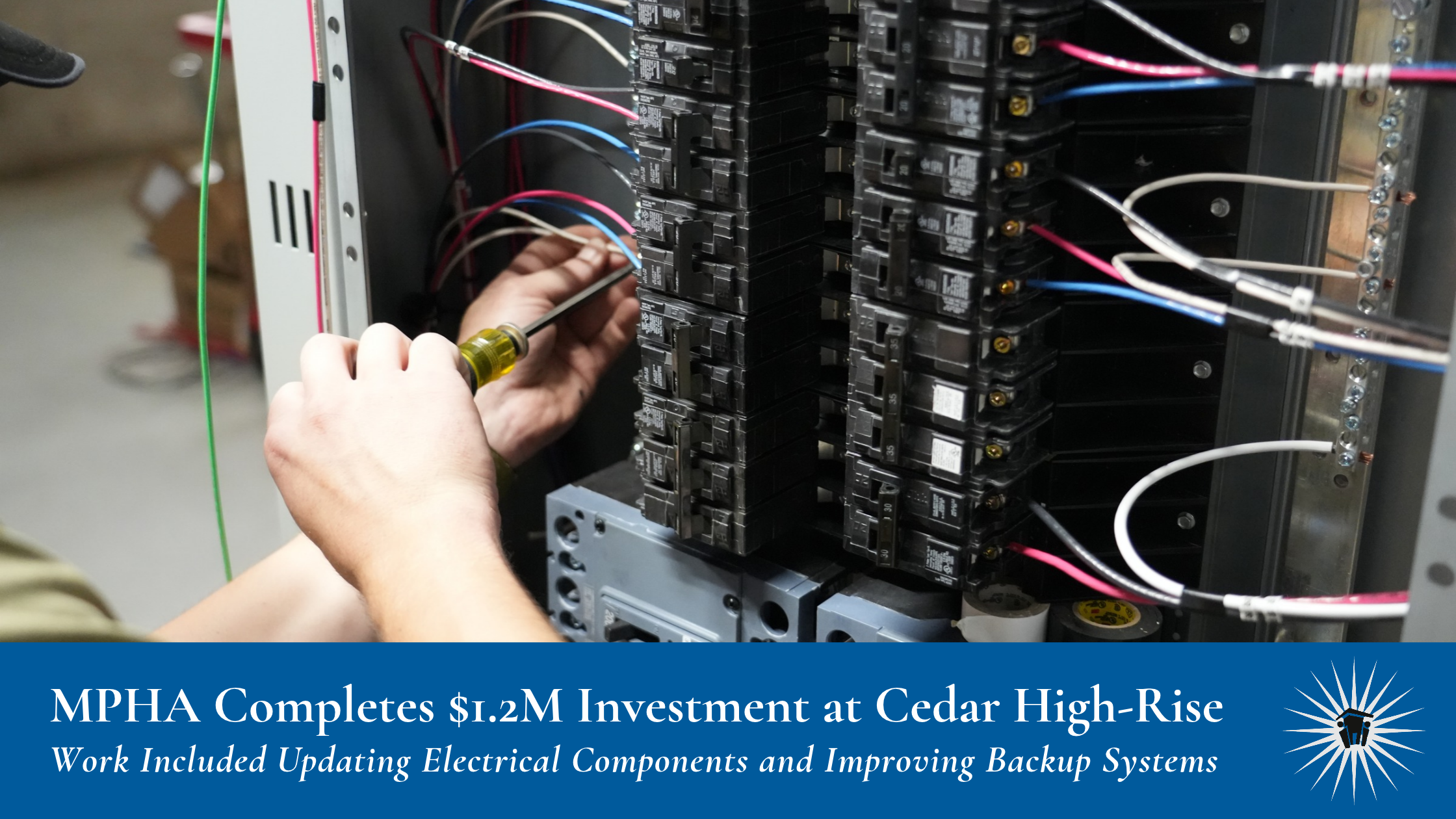
Earlier this month, MPHA completed a $1.2 million electrical components replacement project at the agency’s 630 Cedar Avenue high-rise. The project addressed aging electrical equipment, including electrical load centers that had exceeded their expected useful life and no longer met current city code requirements. The effort was supported by $775,875 in Publicly Owned Housing Program (POHP) General Obligation bonds from Minnesota Housing, awarded back in 2024, with the remaining costs covered by MPHA’s capital fund.
This project at Cedar High Apartments replaced aging electrical equipment and improved the building’s ability to maintain essential services during a power outage. A new emergency generator and associated equipment were installed to provide backup power to critical building systems, including exit lighting, elevators, and key heating equipment. MPHA also replaced several electrical panels and connections serving shared building systems, as well as all in-unit electrical panels. In addition, the building’s fire pump will now receive power from the emergency generator. Together, these upgrades will help keep critical building systems operational and support resident safety if regular electrical service is interrupted.
When Minnesota Housing initially awarded funding for the project in 2024, the project’s estimated cost was $1.9 million, and MPHA was awarded $1.35 million to cover a portion of the anticipated expense. However, bids received for the work came in lower than expected, reducing the project’s overall projected cost. As a result, both Minnesota Housing’s contribution and MPHA’s capital fund contribution were adjusted to reflect the lower cost.
This state funding provided MPHA with sorely needed capital funding assistance to help offset decades of inadequate federal funding. Historically, the U.S. Department of Housing and Urban Development has only provided MPHA about 10 percent of the capital funding the agency needs for major building improvements like this one. That means each year the agency is forced to choose band-aid options to triage leaky roofs, repair and maintain brick façades, replace inefficient 60-year-old windows, or improve decades-old high-rise electrical and plumbing systems instead of more comprehensive—albeit more expensive—solutions. Over time, this problem has only compounded, creating the agency’s current capital backlog of $320 million in needs.
With this project complete, MPHA has strengthened the reliability of the building’s electrical systems. The agency has also begun similar work in three adjacent buildings—funded in part by a $2.91 million grant from Minnesota Housing in 2025. These investments help protect residents, support critical building infrastructure, and ensure the high-rise is equipped for future power outages.
