

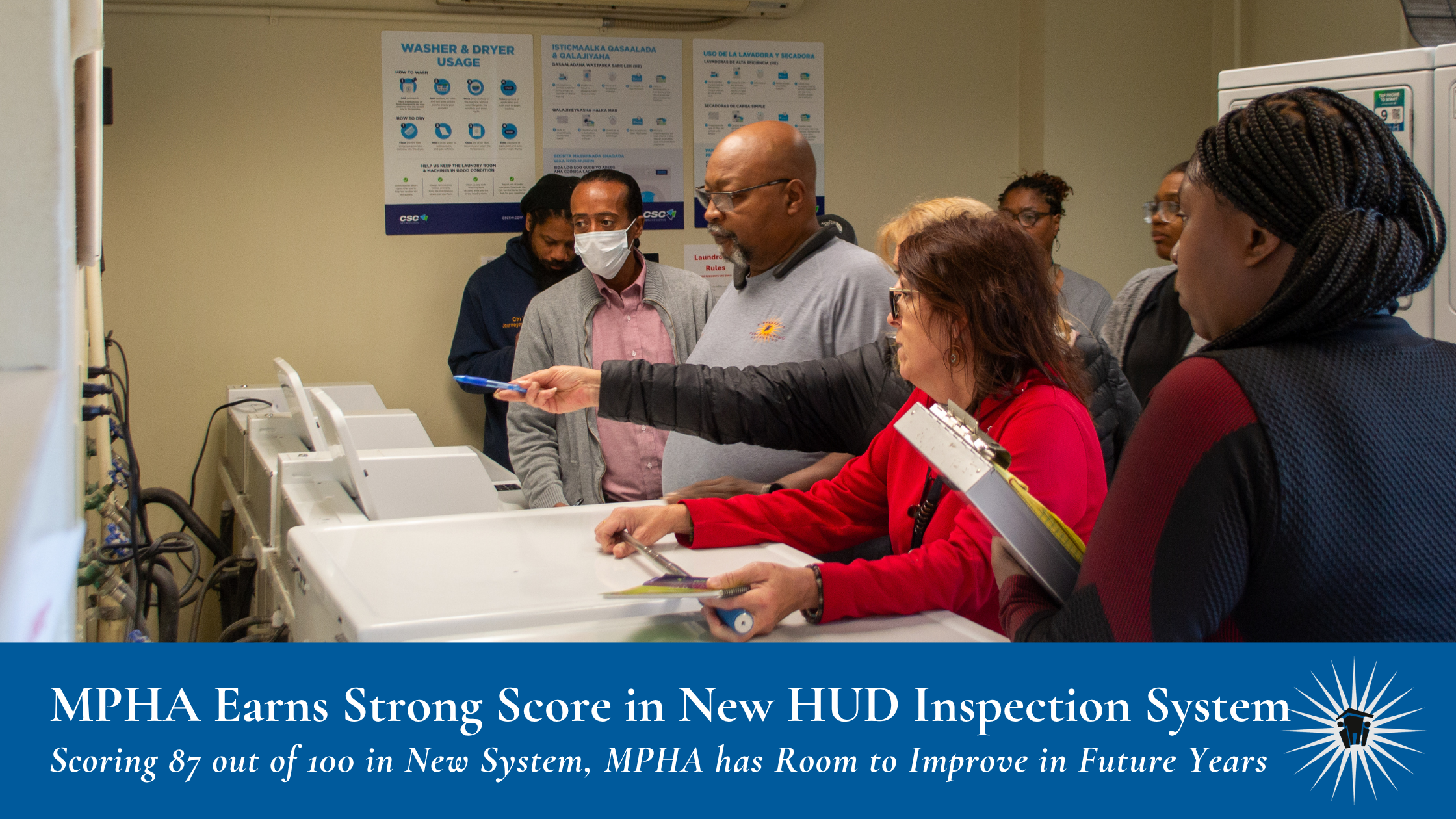
Late last month, the U.S. Department of Housing and Urban Development (HUD) completed its final 2026 inspection of MPHA’s public housing units under its new physical inspection system, National Standards for the Physical Inspection of Real Estate (NSPIRE). Inspections first began in February with MPHA’s public family housing, including Glendale, and concluded in May with MPHA’s Northside high-rises. With inspections concluded, MPHA earned a weighted average score of 87 out of 100 across its public housing portfolio.
“While there is room to improve, this is a strong first score under the new NSPIRE inspection system,” said Abdi Warsame, Executive Director/CEO of the Minneapolis Public Housing Authority. “Our public housing operations team did a great job going from an inspection system staff spent decades mastering to a brand-new system with different measurements and criteria. With the inaugural inspections complete, I have challenged our team to build on this score in the years ahead to meet or exceed the near-perfect scores MPHA scored under HUD’s previous physical inspection system.”
The new INSPIRE system replaces HUD’s long-time Public Housing Assessment System (PHAS) physical inspection. Under the previous system, MPHA scored a near-perfect 98.5 percent.
While inspectors still evaluate conditions inside resident units, building common areas, and building exterior/site conditions, the system places a greater emphasis on health, safety, and habitability inside resident units. With the greater emphasis placed on the interior of residents’ homes, preparing for NSPIRE inspections required MPHA staff to work more closely with residents to comply with the new standards.
In the weeks leading up to inspections, MPHA team members gave up nights and weekends to work with residents, close out work orders, and inspect (and reinspect) units, community/common spaces, and maintenance areas. Through this work, MPHA staff deepened their relationship with residents and created a shared goal among residents and staff of earning excellent NSPIRE scores.
In the end, the agency’s focus on resident units paid off – the agency was assessed very few deficiencies associated with health, safety, and habitability inside resident units. The bulk of the agency’s decencies were moderate/low severity issues that were quickly corrected, primarily in mechanical/electrical rooms and building corridors.
Scores are awarded to each of MPHA’s Asset Management Projects (AMPs), which is the HUD terminology for the geographic grouping of public housing buildings. For MPHA, AMP 1 is Glendale, AMP 2 is public scattered site family housing, AMP 3 is Northside high-rises, AMP 4 is Northeast high-rises, AMP 5 is South high-rises, AMP 6 is Southeast high-rises, and AMP 7 is Southwest high-rises.
To calculate the agency’s weighted average score, the AMP scores are compiled and re-weighted based on the number of units in each AMP. Staggered over the next three years, HUD will reinspect every MPHA AMP, providing agency staff with an opportunity to learn from this year’s inspections to return to the near-perfect scores MPHA achieved under HUD’s previous physical inspections system.
