

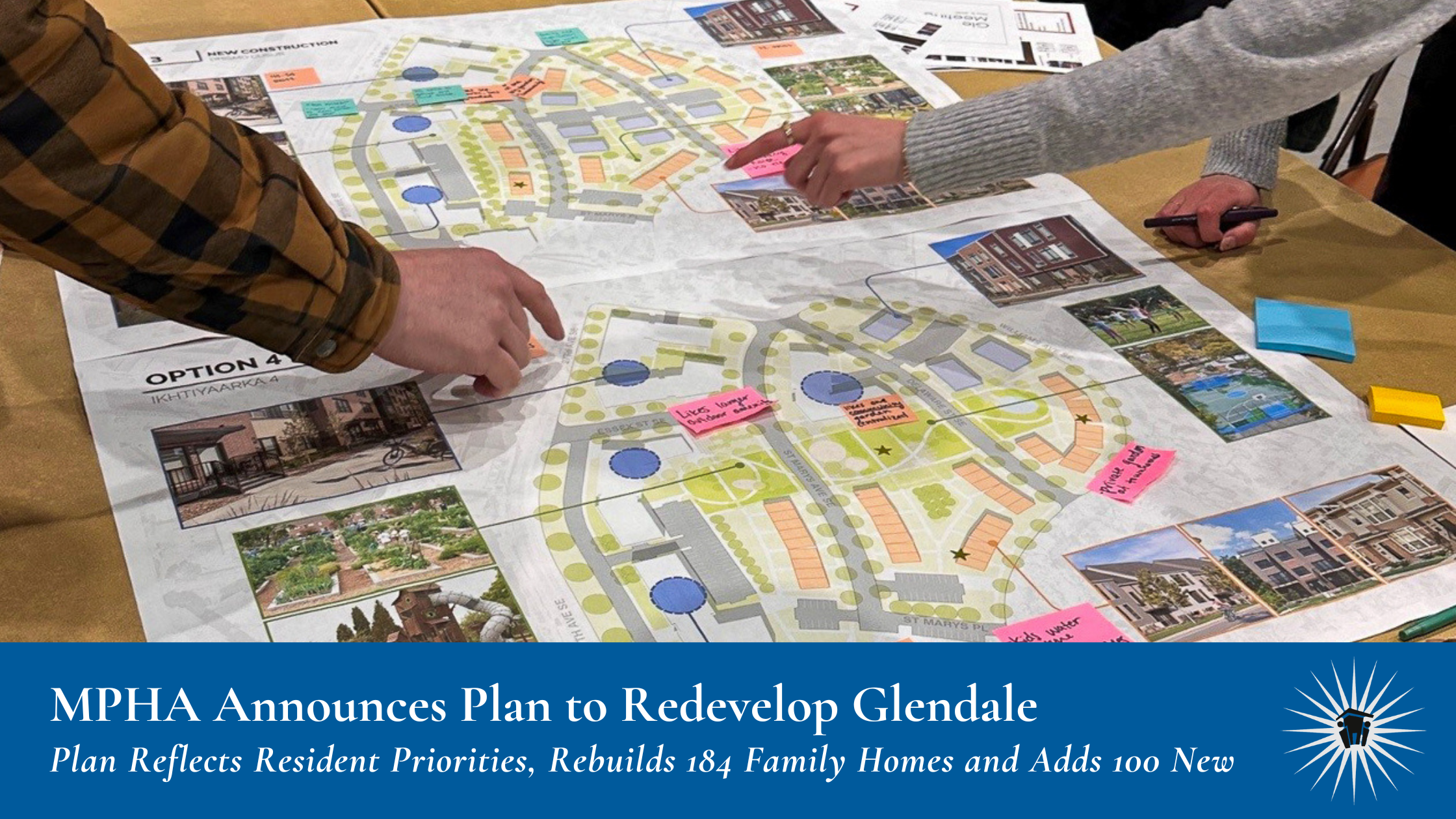
Last week, MPHA unveiled the agency’s plan to fully redevelop Glendale during a resident community meeting. Centered around Glendale residents’ priorities, the two-phase project will completely rebuild the existing 184 homes and add 100 new family homes on the 12-acre site. All 284 units will be federally subsidized, publicly owned and operated, and available to low-income individuals and families—paying no more than 30 percent of their income towards rent.
The project includes a variety of unit sizes, ranging from one- to five-bedrooms. The agency will build these new homes across a mix of housing types, including low-rises, small multiplexes, and townhomes, with accessible and single-level units in multiple building types. In addition to making comprehensive livability, health, safety, and accessibility upgrades to the 74-year-old site, the agency also intends to maintain significant green space across the property.
Construction on the project’s first phase is tentatively scheduled to begin in late 2027/early 2028, contingent on securing the project’s necessary financing. The agency anticipates total development costs across both phases to reach $200 million, making it the largest project MPHA has ever developed and among the largest investments in affordable housing in Minneapolis history.
“This generational investment will serve both the 600 residents who currently call Glendale home and the more than 3,500 families on MPHA’s family housing waitlist,” said Abdi Warsame, Executive Director/CEO of the Minneapolis Public Housing Authority. “MPHA staff have spent 18 months working closely with Glendale residents to co-create this vision of Glendale’s future. This plan balances current residents’ priorities while also creating an opportunity for 100 new low-income families to live in the affluent, amenity-rich Prospect Park neighborhood.”
Since late 2024, MPHA staff have led an extensive resident engagement process to identify resident priorities in any future construction project. Outreach has included resident open houses, community meetings, architect home visits, summer youth/community programming, open office hours, and assembling a resident advisory group that has met regularly throughout 2026. From the onset of this work, agency staff have focused on meeting residents where they are at to best understand their lived experience. The agency has captured and published summaries of all resident engagement activities on its Glendale Townhomes website hub.
Beyond priorities, the most frequent feedback expressed to MPHA staff was fear and confusion surrounding construction-related temporary resident relocation. The agency developed a set of visioning guidelines and action steps detailing the city and federal protections guaranteed to Glendale residents. Agency staff also provided the examples of Elliot Twins, Family Housing Expansion Project, and Spring Manor as recent examples of MPHA successfully relocating resident households during construction and subsequently welcoming them back to their new homes when construction is complete.
Agency staff will begin meeting one-on-one with every Glendale household next month to better understand each household’s unique relocation needs and preferences. Agency staff will use this information to develop relocation contracts and plans that include resident rights and assurances—a process mirroring what MPHA has done with other major redevelopment projects. Agency staff will help households identify available housing options to meet residents’ needs and desires, and to the greatest extent possible, residents will be offered an option to remain on-site during construction.
Every relocated household is guaranteed the right to return to Glendale once construction is complete—a federally protected right. And in all resident relocation plans, MPHA covers any associated moving costs for the household both to and from their home.
With the project direction now set, MPHA staff will host additional resident meetings to finalize site and unit designs along with the project’s full scope. Residents can expect major livability, functionality, accessibility, energy efficiency, and quality of life improvements across the project—both inside the new homes and across the sprawling 12-acre site. Agency staff will also work to maintain the sense of community Glendale residents expressed feeling through the agency’s many engagement sessions.
Next steps for this project include MPHA seeking the necessary city, state, and federal approvals as well as the necessary local, state, federal, debt, and tax credit financing. This starts with Minnesota Housing’s consolidated Housing Tax Credit application next month. The agency will continue to provide regular updates about this project via the Glendale Townhomes website hub.
Current project renderings, recent site imagery, and pictures from resident engagement activities can be found here.
