

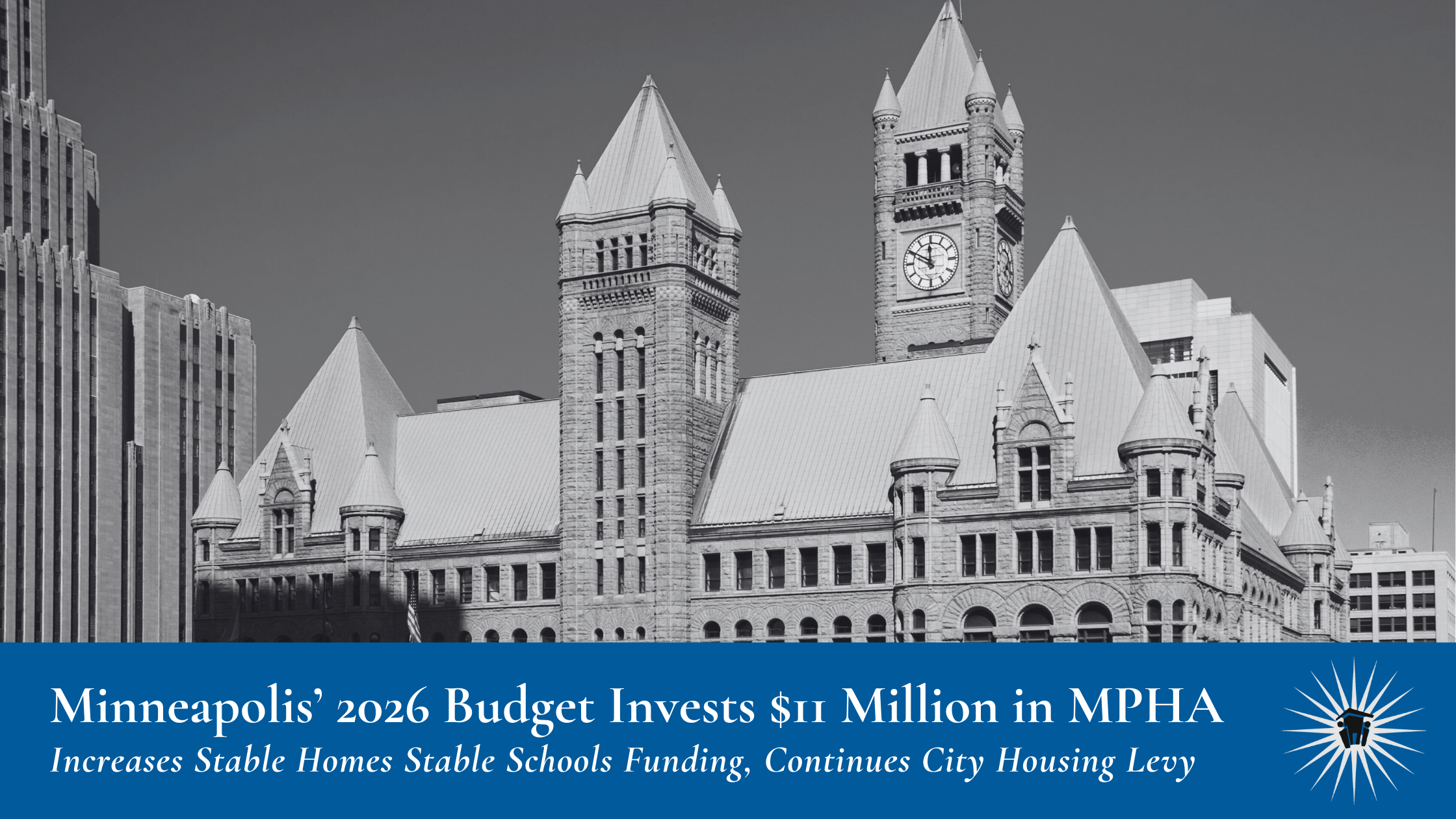
Earlier this week, the Minneapolis City Council finalized the city’s 2026 budget, investing more than $11 million in MPHA programs and activities. Included in this funding is the $5 million annual housing tax levy, $3.6 million in annual funding and $1.4 million in one-time funding for the nationally recognized Stable Homes Stable Schools (SHSS) program, and $1 million in annual funding over the next three years to build a city-funded Emergency Housing Voucher (EHV) pilot to mirror the successful but sunsetting federal program.
Along with the new and deepening investments in MPHA residents and program participants, the City’s 2026 budget includes a new, ongoing $50,000 investment in the Minneapolis Highrise Representative Council to support the Project Lookout program. Project Lookout is a resident-led neighborhood watch program in MPHA’s high-rises.
“I am thankful to Mayor Frey, Councilmember Wonsley, and the entire City Council for deepening the city’s investment in MPHA’s work to address the city’s homeless and affordable housing challenges,” said Abdi Warsame, Executive Director/CEO of the Minneapolis Public Housing Authority. “Amidst the uncertainty of federal funding for housing and homelessness programs, the City of Minneapolis is boldly investing in MPHA’s proven and award-winning programs to meet the needs of our city’s residents. A budget is a moral document, and the City of Minneapolis’ 2026 budget makes clear its commitment to assisting and investing in our community’s most vulnerable residents.”
The agency’s 2026 housing levy budget helps support several projects, including:
- A scattered site infill project like the agency’s internationally renowned Family Housing Expansion Project, albeit on a smaller scale and not using modular construction.
- Comprehensive building rehabilitations at two MPHA high-rises in the Howe neighborhood, coupled with recently awarded funding from Minnesota Housing.
- Pre-development activities at Glendale, including but not limited to paying for professional services like architects, supporting a resident advisory group, and hosting additional community meetings ahead of finalizing a plan for Glendale’s future.
- Modernizing elevators and replacing the boiler plant at an elderly-designated high-rise in the Sumner-Glenwood neighborhood.
Beyond the housing levy, the City of Minneapolis’ 2026 budget includes a $1.4 million annual funding increase for SHSS (now totaling $3.6 million a year), helping close a funding gap the program has incurred since its expansion in 2023.
In recent years, the SHSS funding shortfall has been covered by one-time city funds previously allocated to support the program when it was a pilot. With the one-time pilot funding reserves nearly depleted, MPHA leaders approached Mayor Frey earlier this summer to request a funding increase to SHSS’ $2.2 million annual budget to ensure the program could continue to operate at its current capacity. Mayor Frey included a $1.4 million increase to SHSS funding in his proposed 2026 budget.
In addition to the increase in the program’s annual funding, Minneapolis City Councilmember Robin Wonsley led a successful budget amendment to direct $1.4 million in one-time funding to bolster SHSS as well. The increased annual funding and replenishing of SHSS’ one-time reserves ensures the program can sustainably operate at its current capacity for years to come.
Councilmember Wonsley also led the effort to continue the city-funded EHV program she and Councilmember Jamal Osman established last year. With the program excluded from Mayor Frey’s proposed 2026 budget, Councilmember Wonsley led an effort to amend the budget, initially restoring the $1.4 million funding for the program. The City Council later amended this proposal, changing the structure to a three-year, $1 million-a-year pilot program.
With funding for the EHV program restored, the agency is prepared to deploy this critical resource in partnership with Hennepin County, pending the necessary funding agreement with the City of Minneapolis. The agency needs a funding agreement before the agency can start billing against the appropriated funding and execute the program as visioned. Assuming a funding agreement is promptly reached, the agency anticipates deploying the city-funded EHV in early 2026.
